Meiji Japan in Global History by Catherine L. Phipps
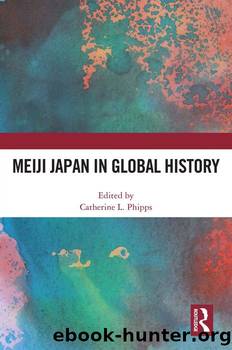
Author:Catherine L. Phipps [Phipps, Catherine L.]
Language: eng
Format: epub
ISBN: 9781000461688
Barnesnoble:
Publisher: Taylor & Francis
Published: 2021-09-30T00:00:00+00:00
Conclusion
The Meiji government created few opportunities for women to pursue higher education, leading ambitious women, such as Tsuda Umeko, to study at American colleges. Several women subsequently travelled to the United States and studied medicine. The existing scholarship has tended to emphasise prominent female physicians, such as Ogino Ginko or Yoshioka Yayoi, who learned medicine without such a global connection. However, I have shed light on the overlooked female physicians who studied at American medical colleges.
The stories of these American-educated female physicians illustrate how they took advantage of globalising trends during the Meiji period. From the 1870s onwards, American female missionaries established mission schools in Japan and initially offered English education to native young women. Some of these missionaries were medical missionaries working as school doctors. The American female medical missionaries were motivated to offer Western medical care and education to Asian women because they believed that Asian women were not benefiting from Western medicine due to the separation of genders. Thus, American female medical missionaries endeavoured to offer not only medical service but also medical education to Japanese women with the expectation that the Japanese women would become their medical assistants. Because of the limited opportunities for women to acquire medical education in Japan, they sent Japanese women to American medical colleges. This overseas study also received financial support from American Christian philanthropists, in the same way as Tsuda Ueko had received aid from several American Christian women. When the Japanese women returned to Japan after earning a medical degree, they often worked as native medical missionaries in dispensaries or hospitals connected to Protestant missions or Christian organisations. Historians are right to note that the Meiji period was the era when American missionaries opened up the possibility of Japanese women becoming educators. I have demonstrated that these missionaries also paved the way for female physicians.
However, the close relationship between American missionaries and Japanese female medical students continued only for the last two decades of the nineteenth century because of changes in the political and medical contexts in Japan. On the political side, the rise of nationalism resulted in anti-Christian sentiment in the late nineteenth century, which disturbed Christian medical work. On the medical side of things, the Japanese government promoted German medicine in its medical schools, resulting in the decline of both American medical missions and American-style female medical education during the same period. Because of both trends, the fact that Japanese women had become Christians and had received medical education in the United States disadvantaged them when they returned to Japan.
In the early twentieth century, Japanese women in medicine and American missionaries individually developed global connectivity. On one hand, American missionaries shifted their focus from female medical education to nursing education because, while German medicine became the dominant model of medical education in Japan, British and American nursing education became favoured among Japanese women. A British-educated physician, Takaki Kanehiro, began the first nursing school in Japan with support from an American missionary nurse, and some women studied nursing in Britain or the United States, supported by American missionaries and charitable societies.
Download
This site does not store any files on its server. We only index and link to content provided by other sites. Please contact the content providers to delete copyright contents if any and email us, we'll remove relevant links or contents immediately.
| Anthropology | Archaeology |
| Philosophy | Politics & Government |
| Social Sciences | Sociology |
| Women's Studies |
The Secret History by Donna Tartt(19086)
The Social Justice Warrior Handbook by Lisa De Pasquale(12190)
Thirteen Reasons Why by Jay Asher(8909)
This Is How You Lose Her by Junot Diaz(6885)
Weapons of Math Destruction by Cathy O'Neil(6279)
Zero to One by Peter Thiel(5801)
Beartown by Fredrik Backman(5754)
The Myth of the Strong Leader by Archie Brown(5507)
The Fire Next Time by James Baldwin(5442)
How Democracies Die by Steven Levitsky & Daniel Ziblatt(5218)
Promise Me, Dad by Joe Biden(5153)
Stone's Rules by Roger Stone(5087)
A Higher Loyalty: Truth, Lies, and Leadership by James Comey(4960)
100 Deadly Skills by Clint Emerson(4924)
Rise and Kill First by Ronen Bergman(4788)
Secrecy World by Jake Bernstein(4752)
The David Icke Guide to the Global Conspiracy (and how to end it) by David Icke(4717)
The Farm by Tom Rob Smith(4507)
The Doomsday Machine by Daniel Ellsberg(4490)
